
Table of Contents
- How to Identify Reputable Online Stores for Pokemon Cards
- How to Spot Fake Pokemon Cards When Buying Online
- Buying Singles vs. Sealed Products: Which Is Right for You?
- Shipping and Delivery: What to Expect from Online Retailers
- Pokemon Card Storage and Protection: Keeping Your Collection Safe
- Best Pokemon Booster Boxes for Beginners
- Loyalty Programs and Price Tracking Tools for Collectors
- Frequently Asked Questions
Last Updated: September 23, 2026
How to Identify Reputable Online Stores for Pokemon Cards
Finding the best online stores for Pokemon cards starts with one question: can you trust what arrives in the post? This guide shows how to separate a genuine retailer from a risky one.
Authenticity Guarantees and Certificates
Authenticity guarantees matter more than flashy photos. A trustworthy store explains how it sources sealed products and whether singles have been checked for tampering.
Ask yourself:
- Does the listing state whether the card is raw, graded, or from a sealed product?
- Is there a clear returns policy if an item turns out to be fake?
- Does the retailer describe its sourcing process at all?
Customer Reviews and Trustpilot Scores
Review scores give a fast read on reliability, but read recent reviews rather than the overall score, a store with a strong rating can still slip on stock availability or delivery speed.
How to Spot Fake Pokemon Cards When Buying Online
Learning how to spot fake Pokemon cards protects your money and your collection. Counterfeits are common on the secondary market, and most fakes fail a few simple checks.
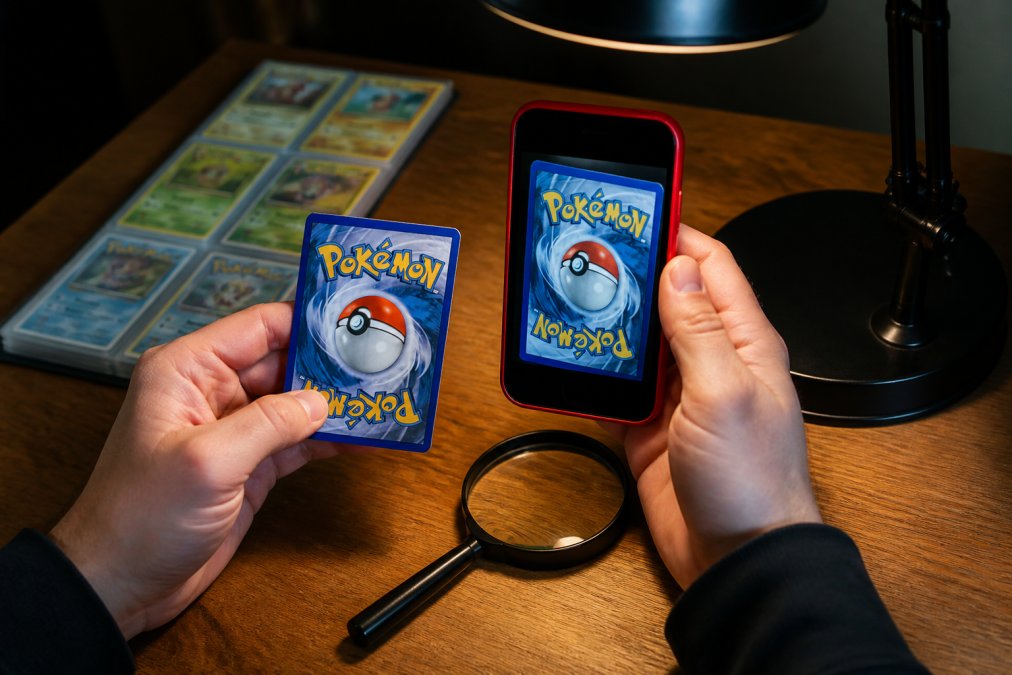
Then check these details:
- Font and spacing: Counterfeits frequently use slightly wrong fonts or uneven spacing in the card text.
- Colour: Compare the card back to a known genuine card. Fakes often look washed out or oversaturated.
- Light test: Hold the card up to a bright light. Genuine cards let a little light through in a consistent pattern.
- Border and cut: Rough or uneven edges point to a counterfeit.
- Rarity symbol: Check that the symbol matches the card's set list and rarity.
Buying Singles vs. Sealed Products: Which Is Right for You?
Singles and sealed products suit different collectors. Singles let you target specific cards to complete a set; sealed products offer the thrill of opening packs and a chance at a rare pull.
| Option | Best For | Main Trade-Off |
|---|---|---|
| Singles | Completing a set, specific cards | Higher cost per card |
| Booster packs | Casual opening, low entry cost | Random results |
| Elite trainer box | Beginners, accessories included | Limited card pool |
| Booster box | Bulk opening, best odds | Higher upfront spend |
Shipping and Delivery: What to Expect from Online Retailers
Delivery speed and shipping costs vary widely, and the lowest sticker price can end up the most expensive once postage is added. Use the framework below to compare delivery before you commit rather than trusting a headline price.
Build a like-for-like shipping comparison
Before ordering, note the following for each shortlisted retailer and compare them side by side:
| What to check | Why it matters | What good looks like |
|---|---|---|
| Free delivery threshold | Changes the true cost of a small order | A clear threshold, stated on the product page, not buried in FAQs |
| Dispatch cut-off time | Determines whether an order ships same day | A stated cut-off (for example, early afternoon) and a stated dispatch window |
| Tracked service as standard | Protects higher-value singles and sealed boxes | Tracking included above a sensible order value, not sold as an upsell |
| Packaging method for singles | Prevents edge wear and bends in transit | Sleeve plus toploader or rigid mailer, stated explicitly |
| Packaging method for sealed product | Protects box condition for collectors | Outer box or padded mailer, with sealed product not crushed |
| Returns window and who pays return postage | Decides how painful a problem order becomes | A stated window and a clear policy on faulty versus change-of-mind returns |
Consumer protection you should rely on
Buying as a consumer from a trader is covered by the Consumer Rights Act 2015, which requires goods to be of satisfactory quality, fit for purpose, and as described. If a card arrives damaged, is not the card listed, or is counterfeit, you are entitled to a remedy, repair, replacement, or refund, and in most cases 30 days from delivery to reject faulty goods for a full refund.
Practical checks before you pay
- Confirm the dispatch location. A retailer shipping from overseas may quote a low price but add customs handling and longer transit, and import VAT or duty can apply on goods above the relevant threshold.
- Check the courier, not just the speed. A tracked 48-hour service from a courier with a poor local record is worse than an untracked 72-hour service from a reliable one.
- Ask how singles are packed if it is not stated. If a retailer cannot describe its packaging for a high-value single, treat that as a red flag.
- Screenshot the listing at purchase. This is your proof of what was advertised if the item arrives different.
Consumer Rights Act 2015 guidance on returning faulty goods
Pokemon Card Storage and Protection: Keeping Your Collection Safe
Pokemon card storage and protection decide whether your collection holds its market value. Cards kept loose in a drawer pick up scratches, bends, and edge wear.
Use these basics:
- Sleeves: Put every card in a penny sleeve before anything else.
- Toploaders or card savers: Use these for valuable singles.
- Binders: Store sets in a binder with acid-free pages.
- Boxes: Keep bulk cards in a sturdy storage box away from sunlight.
- Environment: Store cards somewhere cool and dry, away from direct heat.
Best Pokemon Booster Boxes for Beginners
The best Pokemon booster boxes for beginners have a clear set list, reasonable stock availability, and a price that matches your budget. Beginners do not need the most expensive box on the shelf.
A few practical tips:
- Start with a recent set so cards are easier to trade and sell later.
- An elite trainer box is a gentler entry point than a full booster box.
- Check the set list before buying so you know which cards are possible pulls.
- Buy from a retailer that keeps stock on hand rather than relying on pre-order promises.
Loyalty Programs and Price Tracking Tools for Collectors
Loyalty programs and price tracking tools are where regular collectors quietly save the most money, yet most buying guides skip both. Below: what to look for in a rewards scheme, and a repeatable method for checking whether a store's price is fair.
What a useful loyalty scheme looks like
Rewards schemes fall into a few recognisable shapes. Judge each on the effective discount, not the headline perk:
- Points per pound spent. The simplest model. Work out the real return, for example, if a scheme gives 1 point per £1 and 100 points equals £1 off, that is a 1% return. Anything below 1% is barely worth changing your buying habits for.
- Tiered discounts. Spend thresholds unlock a standing percentage off. Useful if you buy sealed product regularly, less so if you mostly buy singles.
- Subscription or membership perks. A monthly fee in exchange for free delivery or early access to pre-orders. Only worth it if the free-delivery saving exceeds the fee across your typical order frequency.
- Pre-order priority. Early access to allocations matters more than a small discount on in-demand sets, because missing a launch allocation often costs more than any points would save.
- Referral credit. Worth checking if you buy in a group, but treat it as a bonus rather than a reason to choose a store.
A repeatable price-tracking method
Price tracking is the higher-value habit. The goal is not the single cheapest listing, but knowing whether a price is fair for the card's condition and set.
- Identify the exact card. Note the set, card number, rarity, and whether it is raw or graded. A graded card's value depends heavily on the grade and the grading company, so compare like with like.
- Check recent sold prices, not asking prices. Asking prices on marketplaces are aspirational. Sold prices from the last few weeks are the only reliable signal of what a card actually changes hands for.
- Compare across at least three sources. Use a marketplace sold-history view, a specialist card marketplace, and a retailer's single listing. If a retailer's price sits well above recent sold prices, ask why, condition, grading, or a premium.
- Adjust for condition. A near-mint raw card and a played card of the same set can differ substantially in value. Confirm the condition grade the seller is claiming.
- Add shipping and any import costs. A £2 cheaper card with £4 postage is not cheaper.
- Record what you paid. Keep a simple spreadsheet with the card, date, price paid, and condition. Over a year this becomes your own reference for spotting genuine deals.
- Re-check monthly for cards you are chasing. Secondary-market prices on popular cards move, and a card that looked expensive in spring may be reasonable by autumn.
Red flags in a loyalty or pricing pitch
- Points that expire quickly with no clear statement of the expiry window.
- Discounts that only apply to full-price stock, which rarely includes the sets you actually want.
- A store that will not show sold-price history or refuses to discuss condition in writing.
- Prices consistently far below market, this is a counterfeit signal, not a bargain.
Frequently Asked Questions
What is the best shop to buy Pokemon cards online?
The best online store depends on your needs. Look for retailers that offer authenticity guarantees, clear condition reports, and secure packaging. Check Trustpilot reviews and confirm they have stock on hand rather than dropshipping. For beginners, stores with starter bundles and booster boxes are ideal. Always verify the returns policy before buying.
How can I spot fake Pokemon cards when buying online?
Check the card's font, colour saturation, and back design. Fakes often have blurry text, wrong energy symbols, or a lighter blue back. Ask for high-resolution photos of the card's surface and edges. Reputable sellers provide clear images and will answer questions about provenance. If the price seems too low, it likely is. Use a reputable grading company's database to verify slabbed cards.
Which website sells real Pokemon cards?
Websites that sell real Pokemon cards display clear authenticity policies, offer returns, and have positive customer reviews. Look for stores that source directly from official distributors or The Pokemon Company. Avoid marketplaces where individual sellers list without verification. Established hobby shops with an online presence often provide certificates of authenticity for high-value singles.
Where's the best place to buy real Pokemon cards in the UK?
Specialist online hobby shops and official retailers are your safest bet. They often stock sealed products, elite trainer boxes, and singles. Check for a UK-based returns address and customer service. Some stores offer price tracking and loyalty rewards. Always read the shipping and packaging details to ensure cards arrive in mint condition.
Collecting Pokemon cards is more enjoyable when you trust where your cards come from. At Funko Pop Fun Collections, we offer a curated selection of Pokemon cards and exclusive collectibles, backed by clear product listings and a range of Funko Pop! figures from iconic movies, TV shows, and games. Our goal is simple: help you build a collection you will love to display. Search our catalog today and find your next addition.