
Table of Contents
- Best Pokemon Card Protective Sleeves 2026: Quick Comparison
- What to Look For in Pokemon Card Sleeves
- How to Double Sleeve Pokemon Cards
- Perfect Fit Sleeves for Pokemon Cards: When to Use Them
- Are Penny Sleeves Enough for Pokemon Cards?
- Sleeve Sizing, Storage and Long-Term Protection
- Frequently Asked Questions
Last Updated: September 28, 2026
Best Pokemon Card Protective Sleeves 2026: Quick Comparison
Finding the best Pokemon card protective sleeves 2026 has to offer starts with one hard fact: the sleeve market splits into two jobs, and most collectors only buy for one of them. Penny sleeves cost pennies and stop scratches. Deck protectors cost more and survive shuffling. Using the wrong one for the wrong card is how collections lose value.
A card pulled straight from a booster and stored in a penny sleeve will look fine in five years. That same card shuffled weekly in a penny sleeve will not.
Below, we break down finishes, thickness, double-sleeving and storage so you can match the sleeve to the card.
| Sleeve Type | Best For | Protection Level | Shuffle Ready |
|---|---|---|---|
| Penny sleeve | Bulk storage, binder pages | Basic | No |
| Perfect fit (inner) | Double-sleeving, display | High | With outer |
| Matte deck protector | Competitive play | High | Yes |
| Glossy deck protector | Display, photos | High | Yes |
| Textured back | Tournament play, grip | High | Yes |
What to Look For in Pokemon Card Sleeves
The three factors that decide whether a sleeve protects your card are material, thickness and fit. Get those right and the rest is preference.
Matte vs Glossy Finishes
Matte finish sleeves have a textured, non-reflective back that reduces glare and gives a firmer grip during shuffling. Glossy finish sleeves are smoother and show holographic patterns more clearly.
Thickness, Durability and Shuffle Feel
Card thickness is measured in microns, and it directly affects shuffle feel. Thinner sleeves around 60 to 80 microns feel light but crease faster. Thicker sleeves around 100 microns and up hold their shape and resist corner splits.
How to Double Sleeve Pokemon Cards
Double-sleeving means placing a card in a tight inner sleeve, then sliding that into a larger outer sleeve. It is the single best protection method for cards you play with or display, because the two layers cover different failure modes: the inner sleeve stops edge and corner abrasion, the outer sleeve absorbs shuffle friction and seam stress.
Here is the process:
- Place the card face-up into a perfect fit inner sleeve, open edge at the bottom
- Slide the sleeved card into an outer sleeve, with the outer sleeve's opening at the top
- Press out trapped air gently before sealing
- Check the card sits flat with no bowing
Sizing Numbers That Actually Matter
Pokemon cards are standard size, roughly 63mm by 88mm. Inner sleeves are cut to about 64mm by 89mm, a 1mm margin on each dimension. That tolerance is deliberate: too tight and the card bows, too loose and it shifts and picks up corner wear inside the outer sleeve. Outer deck protectors typically run 66mm by 91mm, which is what gives the inner-sleeved card room to sit flat without pressure on the seams.
The Air-Trapping Problem
New double-sleeved cards often look slightly puffed. That is trapped air, not damage. Press the stack gently between two flat surfaces or leave it under a light book for an hour. Do not seal a puffed deck into a tight box, the pressure transfers to the card and can cause a subtle bow that becomes permanent over months.
What Double-Sleeving Costs You
A double-sleeved 60-card deck is noticeably taller and wider than a single-sleeved one. Measure your deck box before committing. Most standard 100-card boxes fit a double-sleeved 60-card deck with room for tokens; slim tournament boxes often do not.
When Double-Sleeving Is Not Worth It
For bulk commons, duplicates, and cards headed straight into a binder page you rarely flip, a single penny sleeve does the job. Double-sleeving is for cards that move: deck staples, trade stock, display pieces, and anything you intend to grade later. The rule of thumb most collectors settle on is simple, if the card is worth more than the sleeves, double-sleeve it.
Perfect Fit Sleeves for Pokemon Cards: When to Use Them
Perfect fit sleeves for Pokemon cards are inner sleeves sized to the card's exact dimensions, typically 64mm by 89mm. They add almost no bulk, which is why they work inside a second sleeve.
Funko Pop! Exclusive Flying Balloon →
Use them when:
- A card is worth more than the cost of the sleeves
- You play the card in a deck and want edge protection
- You store cards upright in a binder or mini album and want a tight seal
Are Penny Sleeves Enough for Pokemon Cards?
Penny sleeves are enough for cards that sit still. They are not enough for cards that get handled. That distinction is where most guides stop, but the more useful question is how much handling, and for how long, before a penny sleeve stops being adequate.

The Handling Threshold
Think in terms of how often a card leaves its sleeve:
- Never leaves the sleeve: penny sleeve is fine indefinitely
- Flipped through in a binder a few times a year: penny sleeve plus a binder page works
- Pulled out to show, trade, or photograph monthly: move up to a deck protector
- Shuffled weekly in a deck: double-sleeve, no exceptions
Where Penny Sleeves Fall Short in Storage
Penny sleeves are also the wrong shape for many modern storage solutions. Side-loading binders are cut to hold a card in a snug sleeve; a penny-sleeved card is often too loose to sit flat in the pocket, so it slides when the page turns and picks up edge wear against the pocket seam. If your binder pockets feel baggy, the sleeve is the problem, not the binder.
When to Upgrade, and to What
- Bulk commons and duplicates: penny sleeves are fine
- Cards in a binder you flip through: penny sleeve plus a binder page works
- Anything you shuffle, trade or display: move up to a deck protector
- Anything you might grade: perfect fit inner plus outer, from day one
The upgrade cost is small relative to the value at risk. A card that grades one point lower because of preventable corner wear loses far more than the price difference between a penny sleeve and a deck protector.
A Note on Longevity
Penny sleeves are not permanent. They cloud, crease, and pick up dust at the open edge. If a sleeve looks cloudy when you hold it to a light, it is no longer doing its job, replace it. Sleeves are consumables, not fixtures, and treating them that way is cheaper than treating a damaged card.
Sleeve Sizing, Storage and Long-Term Protection
Sizing errors cause more damage than bad sleeves. A standard size sleeve fits Pokemon cards, but Japanese size sleeves are narrower and will bow a Pokemon card if you force it in.
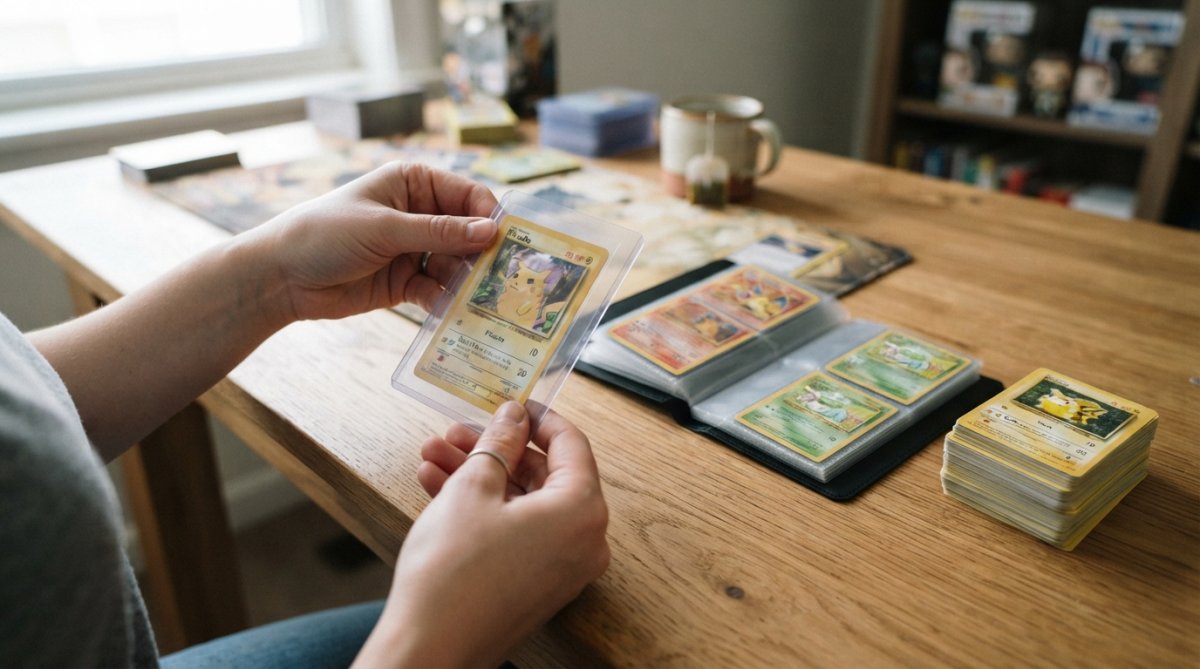
For long-term storage, three things matter:
- Dust resistance and moisture protection: sealed sleeves plus a closed box beat open binder pages
- Deck box compatibility: double-sleeved decks need a larger box, so measure before buying
- Binder and album fit: pocket size must match the sleeve, or the card slides out when you turn the page
Frequently Asked Questions
What are the best TCG sleeves for Pokemon cards in 2026?
The best sleeves depend on how you use your cards. For display and long-term storage, look for acid-free, PVC-free sleeves with a snug fit and a clear front for holographic visibility. For competitive play, textured matte sleeves offer good shuffle feel and tournament legal opacity. Double-sleeving with a perfect fit inner sleeve and a standard outer sleeve gives the best balance of protection and handling.
Are matte or glossy sleeves better for Pokemon cards?
Matte sleeves reduce glare and give a smoother shuffle feel, which suits competitive play and photography. Glossy sleeves show holographic patterns more vividly and are often preferred for display. Neither is inherently better; the choice comes down to whether you prioritise anti-glare performance or maximum visual pop. Many collectors keep both types and switch depending on the card.
How do I prevent my Pokemon cards from bending in sleeves?
Use a rigid outer layer, such as a top loader or a card saver, alongside your sleeve. Avoid overstuffing binders or deck boxes, as pressure causes warping. Store cards flat in a cool, dry place away from direct sunlight. Double-sleeving with a perfect fit inner sleeve adds rigidity and reduces the chance of bending during handling or transport.
Are penny sleeves enough for Pokemon cards?
Penny sleeves protect against dust and light scratches, but they are thin and offer little defence against bending or moisture. For valuable cards, penny sleeves alone are not enough. Use them as a first layer inside a rigid holder or double-sleeve setup. For casual bulk storage, penny sleeves are fine, but high-value cards deserve thicker, acid-free protection.
How do I double sleeve Pokemon cards properly?
Insert the card into a perfect fit inner sleeve with the opening at the bottom. Then slide that into a standard outer sleeve with the opening at the top. This creates a seal against dust and moisture. Avoid forcing the card, as tight fits can damage corners. Double-sleeving is standard for tournament play and long-term storage.
Sleeving a collection properly takes an afternoon, but the wrong choice shows up years later when a card you meant to keep is creased. Start by sorting your cards into storage, play and display piles, then buy sleeves to match each one. Browse the Pokémon cards and collectibles at Funko Pop Fun Collections to build a collection you will love to display, with cards and figures that arrive ready to protect.