
Table of Contents
- How to Spot Fake Pokémon Cards: What You Need to Know
- Common Signs of Fake Pokémon Cards
- How to Identify Fake Pokémon Cards with Texture
- The Light Test and Holo Pattern Verification
- Examining the Back of the Card and Set Details
- Buying Authentic Pokémon Cards Online
- Grading Services and Database Verification
- Frequently Asked Questions
Last Updated: September 29, 2026
How to Spot Fake Pokémon Cards: What You Need to Know
Counterfeit Pokémon cards flood the market every year, and learning to spot fake pokemon cards has become essential for serious collectors. Whether you're building a valuable collection or investing in rare cards, knowing how to identify fake Pokémon cards protects your investment and ensures you're purchasing authentic merchandise.

We help collectors navigate this challenge by explaining the telltale signs of counterfeits. The difference between an authentic card and a well-made fake often comes down to details most casual buyers miss: print quality, texture, weight, and subtle design elements that separate legitimate cards from reproductions.
This guide covers the practical verification methods used by grading services and experienced collectors. You'll learn what to examine, where counterfeits typically fail, and how to build confidence in your purchases.
Common Signs of Fake Pokémon Cards
Print Quality and Resolution Issues
Print quality is where most counterfeits reveal themselves immediately. Authentic Pokémon cards use precise lithographic printing that produces sharp, vibrant imagery with crisp edges on all text and illustrations.

Fake cards commonly show blurry text, especially in smaller print like the Pokédex entry or card number. The rosette pattern, the tiny dots that form images in offset printing, appears irregular or pixelated on counterfeits. Look closely at the card's borders and the edge of the character illustration. Authentic cards have clean, well-defined edges. Counterfeit versions often show fuzzy boundaries or slight misalignment where colours don't meet perfectly.
Ink saturation varies between real and fake cards. Genuine cards display consistent colour depth across the entire surface. Counterfeits frequently show uneven ink application, with some areas appearing washed out or oversaturated. The holo pattern, if present, should catch light evenly without visible streaks or dull spots.
Typography and Spelling Errors
Spelling errors on counterfeit cards range from obvious to subtle. Check the card name, ability text, and attack descriptions for misspellings. Authentic cards are produced with rigorous quality control, spelling mistakes are extremely rare on legitimate releases.
Typography also differs. The font weight, letter spacing, and alignment on fake cards often appear slightly off compared to genuine versions. Examine the set code and card number at the bottom. These should be crisp and properly aligned. Counterfeits frequently show misaligned numbers or inconsistent font sizing.
The Pokédex entry text box presents another verification point. Real cards use a specific font and consistent sizing. Fake cards often substitute fonts or use incorrect spacing that makes the text appear cramped or stretched.
How to Identify Fake Pokémon Cards with Texture
Card Stock and Flexibility
Card material is one of the most reliable ways to distinguish authentic from counterfeit Pokémon cards. Genuine cards use a specific card stock with particular weight and composition. When you hold an authentic card, it has a distinct feel, not too flimsy, not overly rigid.
Counterfeit cards frequently use thinner or lower-quality cardboard. They bend too easily or feel brittle. Some fakes use material that's too stiff, lacking the natural flex of legitimate cards. The weight difference becomes obvious when comparing authentic and counterfeit versions side by side.
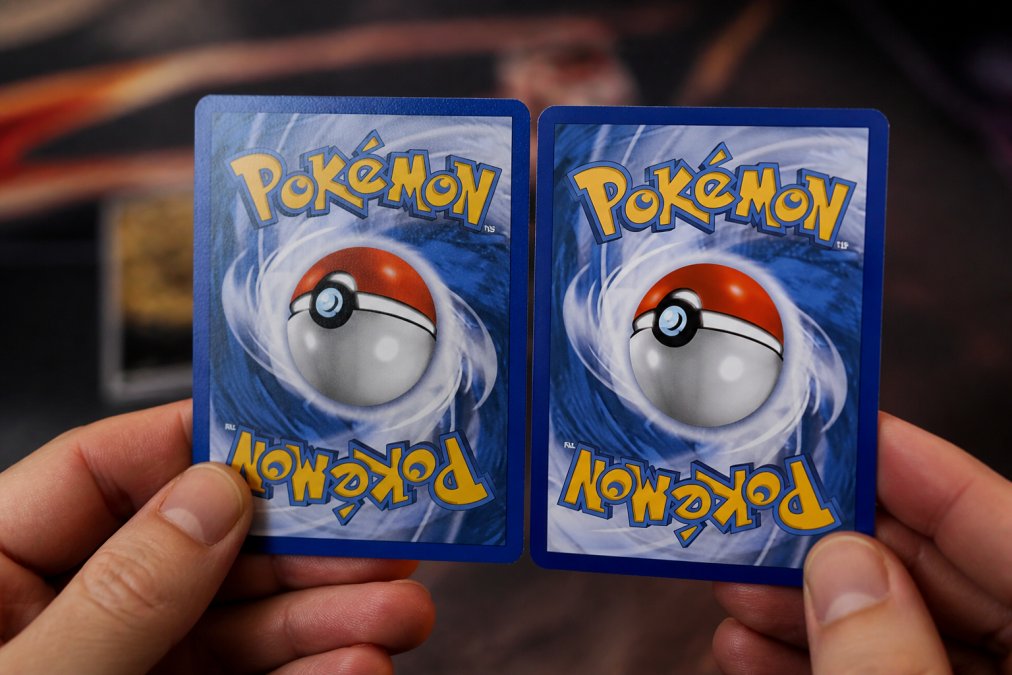
To spot fake pokemon cards, run your fingernail gently across the card surface. Authentic Pokémon cards have a smooth, consistent finish. Counterfeits often feel slightly grainy, waxy, or uneven. Some fakes have a coating that feels plasticky rather than the natural card texture of genuine merchandise.
Surface Finish and Embossing
The surface finish on authentic Pokémon cards includes subtle embossing on the character illustration and the card border. This embossing creates a barely perceptible texture that you can feel when running your finger across it. Genuine cards have consistent embossing depth across the entire design.
Counterfeit cards frequently lack proper embossing or show uneven indentation. Some fakes have no embossing at all, resulting in a completely flat surface. Others show embossing that's too deep or too shallow, creating an obviously artificial appearance.
The holo layer on holographic cards should feel smooth and integrated with the card surface. Fake holo cards sometimes have a separate, raised layer that feels like it's been glued on top. Authentic cards have a seamless finish where the holo pattern is embedded during manufacturing.
Pokemon 30th Celebration Elite Trainer →
The Light Test and Holo Pattern Verification
Hold the card under bright light and examine the holo pattern. Authentic Pokémon cards display a specific holo design that reflects light in a particular way. The pattern should be consistent and symmetrical. Counterfeits often show irregular patterns or light transmission that doesn't match genuine versions.
The light test also reveals print alignment issues invisible under normal lighting. Hold the card at an angle and look for gaps between the illustration and the border.
Examining the Back of the Card and Set Details
The card back contains crucial verification information. Check the set code and card number, these should be crisp, properly aligned, and use the correct font. Counterfeits frequently show misaligned numbers or incorrect formatting.
Buying Authentic Pokémon Cards Online
Purchase from established retailers that verify authenticity. Funko Pop Fun Collections offers a carefully curated selection of Pokémon cards with thorough inspection before dispatch. Our stock includes items like the Pokémon Card Bundle - 50 Card Pack, which guarantees authentic cards with no duplicates, and the Pokémon TCG: Exclusive 30th Celebration Poster Collection for collectors seeking verified exclusive releases.

| Verification Method | What to Check | Authentic Signs | Counterfeit Signs |
|---|---|---|---|
| Print Quality | Text sharpness, borders, edges | Crisp text, clean borders, even ink | Blurry text, fuzzy edges, uneven ink |
| Texture | Card feel, embossing, surface | Smooth finish, consistent embossing | Grainy feel, missing embossing, waxy texture |
| Holo Pattern | Light reflection, pattern design | Consistent pattern, proper light reflection | Irregular pattern, poor light transmission |
| Card Back | Set code, Pokédex text, alignment | Proper alignment, correct text, matching colours | Misaligned numbers, spelling errors, colour variations |
| Weight and Flexibility | Card stock quality | Appropriate weight, natural flex | Too flimsy or too stiff, unusual feel |
Grading Services and Database Verification
Professional grading services like PSA (Professional Sports Authenticator) and Beckett Grading maintain databases of authenticated cards. If you're considering a high-value purchase, checking whether the card has been graded by a recognised service provides near-certain verification.
Using Grading Service Serial Numbers and QR Codes
- Locate the serial number on the grading slab. PSA cards display a 6-8 digit number on the label; Beckett cards show a similar format.
-
Visit the grading service's official database:
- PSA: Use the PSA Set Registry or PSA Card Search at psacard.com. Enter the serial number in the search field.
- Beckett: Use the Beckett Grading Services lookup at beckett.com. Search by serial number or card details.
- Cross-reference the results. The database will display the card's grade, set, card number, and condition assessment. Verify that the card in front of you matches the database entry exactly, same set, same card number, same grade.
- Check for QR codes. Modern grading slabs include QR codes that link directly to the card's authentication record. Scan the QR code with your phone; it should open the grading service's official verification page. If the QR code doesn't scan or links to an unfamiliar website, the slab is counterfeit.
Verifying Against Official Pokémon TCG Databases
- Identify the set code printed on the card's bottom edge (e.g., "Base Set" = BS, "Jungle" = J, "Fossil" = F).
- Note the card number (e.g., "25/102" means card 25 of 102 in that set).
- Cross-reference with Bulbapedia or TCGPlayer's database. Search for the set and card number. The official record will display the correct artwork, text, HP, attacks, and rarity symbol.
-
Compare your card against the official image. Mismatches in artwork, text, or layout indicate a counterfeit. Pay special attention to:
- Holo pattern design (varies by era; modern counterfeits often use generic patterns)
- Pokédex entry text (must match word-for-word)
- Set symbol and rarity icon (design and placement must be exact)
- Card borders and background colour (should match the official release)
When to Invest in Professional Grading
Red Flags in Grading and Slabs
- Serial numbers that don't match the grading service's database
- QR codes that don't scan or link to unfamiliar websites
- Spelling errors or inconsistent formatting on the slab label
- Mismatched card details between the slab label and the card itself
- Slabs with poor print quality, faded labels, or loose encapsulation
- Cards graded by obscure or unrecognised services (stick to PSA, Beckett, and CGC, the three major authenticators)
Frequently Asked Questions
How do I verify a Pokémon card is authentic?
Verify authenticity by checking multiple factors: examine print quality for sharpness and colour accuracy, feel the card stock texture for proper flexibility and weight, inspect the holo pattern for the correct rosette pattern reflectivity, and verify the set code and rarity symbol on the card back match official records. Combine these checks rather than relying on one alone. Counterfeit cards often fail on texture and ink saturation simultaneously.
What are the most common signs of fake Pokémon cards?
The most obvious signs include blurry text and pixelated images, spelling errors on the card or packaging, incorrect card stock that feels too thin or too rigid, missing or incorrect holo patterns with poor light transmission, and misaligned printing. The card back often reveals counterfeits through incorrect colour reproduction, wrong font sizing, or missing the Pokéball design elements. Weight discrepancies also indicate fakes, authentic cards have specific GSM requirements.
Can I use a light test to identify fake Pokémon cards?
Yes. Hold the card up to a bright light source and look for light transmission through the card stock. Authentic cards have consistent, even light transmission across the entire card. Counterfeits often show uneven light patterns or excessive glare. Additionally, examine the holo pattern under light, authentic holos display a precise rosette pattern with specific reflectivity, while fakes typically show blurry or distorted reflections. This test works best in a controlled lighting environment.
Where should I buy authentic Pokémon cards online?
Purchase from reputable retailers that verify stock on hand and inspect items before dispatch. Funko Pop Fun Collections offers sealed, authenticated Pokémon products including the Pokémon 30th Celebration Elite Trainer Box and curated card bundles, all inspected for damage and repackaged to ensure pristine condition upon arrival. Avoid sellers offering unusually low prices or dropshipping models, and always check return policies before purchasing.